
You must log in or # to comment.
But of trivia about the first IBM hard drive: the heads weighed about 8g each and were glued to the actuator arms. The platters needed periodic cleaning, but the cleaning agent dissolved the glue holding the heads. The heads would break free from the arms and adhere to the platter. The rotation speed would accelerate the head outward, and the head would exit the housing with the approximate kinetic energy of a 9mm bullet.
Yes kids, before color TV was commonplace people would stand around and watch cargo get loaded for fun. It was a dark time in entertainment history.
Hey if someone told me I could go see the 2025 equivalent of this hard drive being unloaded if probably go take a look.
What would that even be?
Server rack with a couple of PBs worth of drives in it would probably match the physical size. Or a massive tape archive storage.
The spectacle and witnessing something revolutionary makes the person feel like they’re a part of history. A modern equivalent is any time that happens. The article is irrelevant, whether it’s a huge hard drive or an artificial heart or a robotic arm or a human dinosaur hybrid being loaded into a cargo crate doesn’t matter.

Someone please photoshop (or gimp) hundreds of people crowded around these fingers.
This was definitely true in the 80s where I grew up
Tbh they could be waiting for the path to clear so they could get past
I was in Turkiye a couple years ago and there was a crowd watching a construction site. Then again, watching big machines work actually is fascinating.
This honestly just makes me wonder how chill a workday was if three whole buildings of office drones could empty into the streets to watch them load this for two hours.
My brother in christ, you have no idea. The rise of the computer age and needing round the clock support for all that entails has really done a number on the working class. I am old enough to remember how chill work environments in the 80’s and early 90’s were. (Everyone smoking indoors sucked, though)
I considered editing my comment to reference the rampant secondhand smoke.
But yeah I just interviewed for a position with an on-call rotation. I asked them about sleeping hours, and then I asked them about attendance expectations in the face of a midnight emergency. They just blinked at me.
Good luck to you man. I went through that for a long time but those days are behind me now.
The invention of clocks ruined the workday as well.
Average size JavaScript file 2025.
In megabytes or in m3?
And that’s after minifying it to oblivion for security and hackproofness
That thing probably made worse grinding noises than The Mangler
Little virgin blood and bat dung, that thing’s hopping around eating people.
Back then, the prefix ‘mega’ still meant something.
What would have happened if we just dropped a 20tb hard drive in front of the computer researchers of that time?
World war? Aliens? Or just trashed due to how advanced the tech in it would be to them? Yeah, I think the last.
What would have happened if we just dropped a 20tb hard drive in front of the computer researchers of that time?
Nothing, they would have no idea what it was, or how to interface with it. They might even end up destroying it because they have no idea of the power requirements. Even if they managed to get it powered up and guessed at what it was for, they would still be stuck with the issue of not having an operating system which is capable of logically addressing all of the storage. And the lack of drivers would make that even harder.
A lot of modern technology sits atop a mountain of other modern technology which must be sorted out before you can even start to think about designing the end product. It could be that, since they knew what was possible, and had an example to crib off of, scientists and engineers could have gotten to that point faster. But, there is just an insane amount of prior tech in front of modern computers that any one piece of it, thrown back that far, would likely just be shiny junk.
The power requirements are printed right on the label tho…also they had x-rays back then too.
Yeah that or aliens.
The hard drive controller has a dual core cortex-r that was more powerful than all the computers in existence at the time.
One of my favorite things about what you are saying is modern transistor gates are smaller than microscope resolution at the time. Even if they could recognize an integrated circuit it would be another 10-20 years before they could even start to reverse engineer it.
You would be burned as a witch.
I way more than a duck though
Do you weigh more than a duck with an anvil?
Guess that depends on the anvil https://www.anvilfire.com/anvils/af_anvils-largest.php
Printed circuit boards were becoming “commonplace” (according to Wikipedia) and the transistor had been invented about 9 years before, so they’d probably be able to figure out at least conceptually what they were looking at. In other words, it’s not as if it would seem like a magical rock etched with runes or something, like it would if you showed it to somebody from 1556.
Therefore, I think they’d get out a microscope and oscilloscope and start trying to reverse-engineer it. Probably speed up the development of computer technology quite a bit, by giving them clues on what direction to go.
Therefore, I think they’d get out a microscope and oscilloscope and start trying to reverse-engineer it. Probably speed up the development of computer technology quite a bit, by giving them clues on what direction to go.
Knowing what something is doesn’t necessarily teach people how it was made. No matter how much you examine a sheet of printed paper, someone with no conception of a laser printer would not be able to derive that much information about how something could have produced such precise, sharp text on a page. They’d be stuck thinking about movable metal type dipped in ink, not lasers burning powdered toner onto a page.
If you took a modern finFET chip from, say, the TSMC 5nm process nodes, and gave it to electrical engineers of 1995, they’d be really impressed with the physical three dimensional structure of the transistors. They could probably envision how computers make it possible to design those chips. But they’d had no conception of how to make EUV at wavelengths necessary to make the photolithography possible at those sizes. No amount of the examination of the chip itself will reveal the secrets of how it was made: very bright lasers pointed at an impossibly precise stream of liquid tin droplets against highly polished mirrors that focus that EUV radiation against the silicon and masks that make the 2-dimensional planar pattern, then advanced techniques for lining up 2-dimensional features into a three dimensional stack.
It’s kinda like how we don’t actually know how Roman concrete or Damascus steel was made. We can actually make better concrete and steel today, but we haven’t been able to reverse engineer how they made those materials in ancient times.
Cute how the IBM logo basically hasn’t changed
Fun fact: it used to have 13 bars, but changed to the current 8 because 13 bars could not be made pretty on (8-pin) matrix printers.
Fun fact: exactly once, the team organising IBM’s participation in the Copenhagen Pride parade got away with wearing t-shirts with the bars printed in the rainbow colours. Immediately after, they were notified that such alterations to corporate branding was unacceptable.
^(I cherish the two shirts I still have.)There once was an official IBM logo issued in rainbow colours in 2017:
https://page-online.de/kreation/wie-man-mit-einem-logo-politisch-farbe-bekennt-zeigt-ibm/
Good on corpo for allowing that. That was after I left (and in a different country) so I wasn’t aware.
In a similar sense, this is one of my favorite historical photos. A nuclear reactor delivered by steam locomotive!
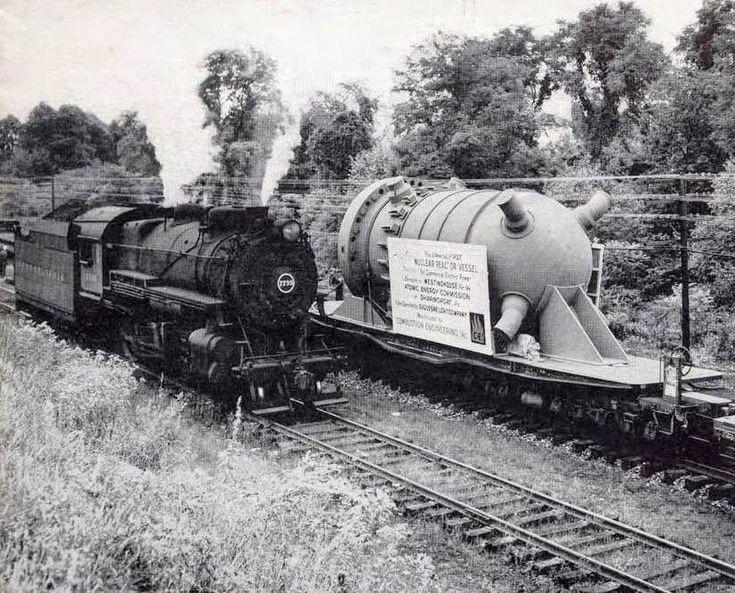
When was this taken?
I’m out and about right now so I can’t look it up, but most likely during the 50s. The United States transitioned away from steam in the 50s and was largely transitioned to diesel by the early-mid-60s
Edit: this xitter xeet says 1957 which seems very plausible (and applied a filter to the photo for whatever reason) Also while reverse image searching in hopes of finding more details I found this very post but federated to dbzer0.com
Oddly the nuclear reactor has more in common with a steam locomotive than a diesel since they both generate power via steam.
I almost added a joke about it being a photo of 2 steam power plants, but figured that might be a bit too obscure for !pics@lemmy.world
#Retvrn
And now I have a phone capable of taking photos too large to be stored on that drive. Crazy how quickly technology can progress.
Crazy how quickly technology can progress.
70 years is a long loooooooooooooooooong time for “technology”
Only recently! For the past 10,000 years a 70-year span would not see a single significant change.
(If I mix this up, someone correct me.)
I think it was at Olduvai, or somewhere in the Great Rift Valley, that hominids spent 600,000 years hammering out the same exact stone tools.
that’s why i put “technology” in quotation marks.
I mean, yeah, that’s what he was getting at. How 70 years seems like a long time in the context of modern technology despite being very short in the sense of human history.
It is nowadays, and it is in RF and digital electronics, but that’s far from universal.
They all wore pants back then.
Imagine what a HDD of that size could store today.
At least one call of duty game, sick!
What could it?
Estimate the volume of that box then calculate how many data centre grade HDDs would fit inside to get a rough idea
About 10 ‘AAA’ game titles, I’d say.
Not including their first update.
Or GTA6
or one Call of Duty patch
Minimum 10 MB I’d say.
This guy knows computers.
No, just hard drives.
no fucking way
That’s a bold assumption.
At least 1
node_modules
Look at that back form, my gosh.
As you can see from the sign, hard drive parking had not yet been invented.
The start up sound must’ve been legendary