
- cross-posted to:
- science_memes@mander.xyz
You must log in or # to comment.
Ain’t no marshmallow worth waiting 5 minutes for.
The original experiment boils down to being a zip code test anyway
Double-blind placebo controlled randomized skin color test
Well, was it worth learning that about it?
deleted by creator
deleted by creator
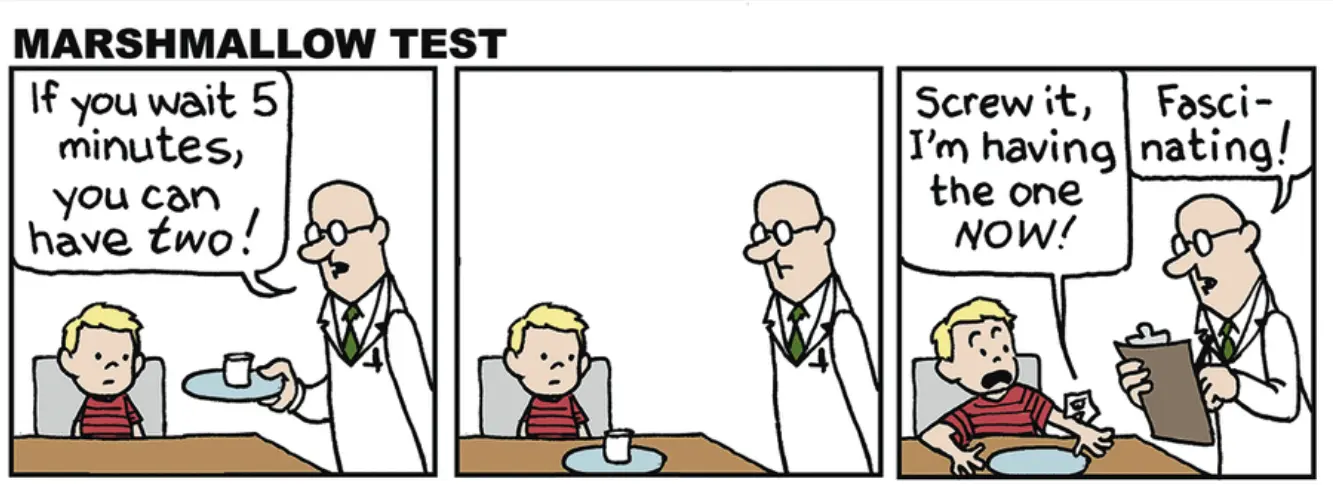
It’s not the kid who didn’t wait…
The marshmallow is eating the kid, not the other way round.
I think it’s that he waited 5 seconds and got zero marshmellows?
Or he ate it already between the 2nd and 3rd panel, and is demanding the second one?
I didn’t get it til another poster pointed it out – instead of the kid eating the marshmallow, the marshmallow is biting the kid’s arm.
I glanced over the comic a couple times, and each time I saw the kid tossing the marshmallow in the air as if to catch it in his mouth.
Oohh!
The joke is that in this version of the experiment, the child isn’t being tested, the marshmallow is. And in this case, the marshmallow has decided to eat this one child instead of waiting until later, when it would have been allowed to eat two children.
deleted by creator
Same, was confused until I zoomed in.
Same! Man this really needs an edit where the marshmallow is biting from there opposite side of his arm.
I always found this study to be lacking…
5 minutes is not worth 1 marshmallow. Marshmallows are not that good, so one is way enough. As a kid, I could never trust adults who wanted to limit good things. Who’s to say the strange adult in a white coat would really bring a 2nd marshmallow? What if they actually remove the marshmallow instead?
In short, it can only separate kids in two groups: the blind followers of authority and the other ones.
They should have done cookies instead.
And sweeten the deal. 1 cookie or a BAG… Yeah, give me a BAG it cookies, yeah. I’m an ADULT.
This is what I’ve said since I learned of this experiment. I’m only waiting for the second marshmallow if BOTH of the following statements are true:
-
I want two marshmallows.
-
I trust the adult to keep his word.
-
Time to calculate how much 1 marshmallow is worth in time considering minimum wage in my country.
Let’s begin.
Minimum wage in Slovakia is €4.69/h.
An 80g bag of Jojo marshmallows is €1.19 at Tesco.
It claims one portion is 3 marshmallows which is 11.7g.
Therefore 1 marshmallow is 3.9g.
Therefore there are 20 - 21 marshmallows in the bag.
Therefore 1 marshmallow costs roughly €0.058.
€4.69/h is €0.078/m or €0.0013/s.
Therefore, 1 marshmallow costs roughly 44.62 seconds of work time.Well, assuming there are no taxes. So maybe something close to 1 minute per marshmallow. Although… maybe if we add total time, including time you’re not working… 12 marshmallows an hour, 288 a day, 2016 a week, 8640 a month. That’s €501.12/month.
Based on this the minimum monthly wage after taxes and all is €661.80/month.
Conclusion: It is worth the 5 minutes.
As a kid, I could never trust adults who wanted to limit good things.
Guess what? This effect has been found in other experiments!
The marshmallow experiment is one of those that self-help gurus and LinkedIn ‘influencers’ love to peddle as being meaningful, in no small part because it tells people who had lucky upbringings that they are inherently better than others, and not just a product of their environment. But when it’s actually examined critically, it falls apart.
Marshmallows are bad. 2 would be a punishment.
We did this in church with maltesars
Way better than marshmallows!
I think we were also given 3. We were given one at the start of the small sunday school class, and if we had it at the end of it, we were given three more. So the difference was that if you ate it early, you still would have had to wait anyway.
Won’t it melt from the heat in your hand/pocket? I ain’t having chocolate stains in my pocket, I’m eating it now.
It was sitting on the table
deleted by creator
The best play is to eat the marshmallow immediately so that the experimenter moves onto the next test.
I would give you an upvote now, but I’d rather delay my gratification give you 2 later
A shower thought about the original experiment:
It may have only measured how effective “waiting for future gains” was, as a strategy, for each child, in their circumstance.
So the real discovery may be only that the children already had a pretty good idea how promising their own futures were. :(
Or hungrier kids (aka poorer kids) get the marshmallow first. Or those in greater need of serotonin (at least I think it’s serotonin) you get from sugar, etc. There’s a variety of issues here, but that’s true of most “experiments” that aren’t actually randomized controlled trial experiments.
Or it measured how rare it was for them to get candy. The most interesting thing about the experiment is honestly the many ways in which it was flawed.
Or they’re just natural born addicts like myself and need that instant reward and think to hell with my future self. That’s his problem. Present me just got a marshmallow.
deleted by creator
Hobbes will avenge him
I would ask for a grill and stick while waiting. A slightly burnt marshmallow is worth the carcinogen.
….will there be a new one every 5 minutes?
Turns out the test is only a good predictor of “how well you can trust the adults in your life to keep their words”. Which tells more about the envirement than about the kid.
Why is this slightly calvin but not quite
Such a silly experiment. You’re gonna make them sit and be bored for five minutes with nothing else to do besides thinking about two marshmallows?
This is a cognitive task aiming to assess whether kids can trade a small reward now for a bigger one later (it tests inhibitory control and ability to project oneself in the future). This experiment was conducted by comparative psychologists and, if I recall well, they also compared the kid’s performance to that of some primates to understand the evolution of the human mind.
I get that, I’m just pointing out that depending on how it was conducted it may have been silly. Sort of similar to that test where there’s nothing in a room but a button that shocks you and people got bored and shocked themselves. I’m not suggesting the study is invalid, I assume the researchers know better than me, but I could also see something like a kid just sitting at a table with literally nothing to do but salivate about the thought of two treats for a time period. Seems like a better test would be something like letting kids play and then doing this (which could’ve been what was done. It’s just that the comic seems to imply otherwise.)
Store-bought marshmallows are one of those things where I only really want one.
There’s an ice cream shop few towns over that makes fresh, exotic flavored marshmallows, depending on the day they’re better than sex. But even those are about the size your fist and honestly two would be a little bit too much.
You might want to try a different brand of sex tbh. It’s gotta have serious issues to get beaten out by some fluffy sugar.
Tell me where
The Charmery Columbia, MD.
Haven’t been there in a year, you’ll prob want to call and make sure they’re still doing them. Not all the locations sell it. (At least they didn’t)
This experiment was not specifically about whether a kid would wait for the second marshmellow or not (which would be delayed by 20+ minutes), nor whether they would play with the roomful of toys, but to see how they grew up. The real test was to catch up with the adults and see how ‘successful’ they’d become. The experimenters found that those children who waited for the second marshmellow achieved higher grades and had more ‘successful’ better-paying careers.
It’s the concept of delayed rewards vs immediate rewards and is prevalent in the world of machine learning.
later replications of the test showed that the difference between kids waiting or not, and successful or not was significantly related to their parents financial status, in other words, the broke kids ate the stuff that was in front of them, because they learned that promises are not always kept
A bird in the hand is better than two in the bush!
Excerpts from Wikipedia:
A replication attempt with a sample from a more diverse population, over 10 times larger than the original study, showed only half the effect of the original study. The replication suggested that economic background, rather than willpower, explained the other half.
Work done in 2018 and 2024 found that the Marshmallow Test “does not reliably predict adult functioning”.
It’s great for a confirmation bias, but such a study is way too simplistic to really reach a conclusion. Oh, and:
The results seemed to indicate that not thinking about a reward enhances the ability to delay gratification, rather than focusing attention on the future reward.