
‘But there is a difference between recognising AI use and proving its use. So I tried an experiment. … I received 122 paper submissions. Of those, the Trojan horse easily identified 33 AI-generated papers. I sent these stats to all the students and gave them the opportunity to admit to using AI before they were locked into failing the class. Another 14 outed themselves. In other words, nearly 39% of the submissions were at least partially written by AI.‘
Article archived: https://web.archive.org/web/20251125225915/https://www.huffingtonpost.co.uk/entry/set-trap-to-catch-students-cheating-ai_uk_691f20d1e4b00ed8a94f4c01
I think the only solution is the Cambridge exam system.
The only grade they get is at the final written exam. all other assignments and tests are formative, to see if they are on track or to practice skills… This way it does not matter if a student cheats in those assignments, they only hurt themselves. Sorry for the final exam stress though.
I had a couple classes in college where the grade was 8% homework, 42% midterm, and 42% final exam. Feels a bit more balanced
I think we should also be adjusting the criteria we use for grading. Information accuracy should be weighted far more heavily, and spelling/grammar being de-prioritized. AI can correct bad spelling and grammar, but it’s terrible for information accuracy
What were the other 8 percent?
also bad at synthesizing new ideas… however, it is likely that future models will be better at those things.
then whole situation sucks and I’m glad I’m out of uni.
My math undergrad classes were largely like that, too, and that was before there were smartphone solver apps, let alone “AI”. A typical grade breakdown was 10% assignments, 30% midterm, 60% final in first and second year. Then in third and fourth year, it was entirely midterm + final.
They gave a few marks for assignments in lower years since high schoolers often come to them thinking the only things that are important are grades, so won’t practice unless it’s for marks. If you haven’t figured out that practice is important by third year…
And agreed re: changing the focus of our assessment, just like memorizing facts for history “trivia-style” assessment should no longer be used by anyone in a post-search Web 2.0 world. (Although it was never good assessment, regardless.)
What is a “Cambridge exam system”?
Meant how the university of Cambridge does their tests. rather than year long exams and assignments being a fraction of your grade. the only grade that matters is that of the final yearly exam. I think it is the only one in the UK that does that. not sure how it works in the rest of the world, but I think that is rare. but likely the only AI proof system.
IE, you can literally goof off the whole year, not even be in town, and if you show up for the exam and ace it you get a good grade.
God that’s great. I’ve failed classes in Uni where I got As on all the tests, just because I didn’t do the homework >:0
Classes like Calc 2,3, Thermo/fluid dynamics, chem classes etc never had required homework for me, just suggested. The only classes with required homework were engineering projects building something physical or programs I had to submit in C or what not. I suppose I had a writing course that required I turned in essays, but I don’t know how you’d get around that.
Or reversly, you have one bad day
yhea, I think you can take then again if you fail. not a good day to wake up with a migraine
A significant percentage of my classes at University were a midterm and final, or just a final. I thought they worked just fine.
I took three history classes while I was in college. It’s been a while, but I recall most of them having a paper or two and those papers counting for a pretty big chunk of you grade. The author of the article is a history teacher, so essays make some amount of sense.
My engineering classes were basically as you described.
My engineering classes were basically as you described.
Because engineers need to get it done the first time. No room for bullshit.
Except this is terrible for a lot of people and then only measures how well people do at taking tests.
I’m open to alternatives that can’t be chatgtped. tech bros destroyed them all
I’m guessing 33 people were too lazy to copy data into a box and relied on ChatGPT OCR lol.
This was a great article about the use of AI, but I think this also exposed bad/zero effort cheating.
There’s a reason why even the ye olde Wikipedia copy-pasters would rearrange sentences to make sure they can game the plagiarism checker.
Microsoft Word had auto summarize as far back as the early 2000s (and probably before then, I only found it my junior or senior year of high school). Plop a wall of text into a word docume, click auto summarize, limit the number of direct quotes to three words max, hit enter. I was clever af (except that one paper on Gorbachev where the paragraph entirely composed of wingdings exposed my strategy a bit), or so I’d have thought.
Lo and behold my cheating somehow didn’t prepare me for regular life, and so I had to learn lessons in college (the one year that I went), and early on in my career, in my early 20s, that I should’ve learned in school. The lesson was that you sometimes need to just do the fucking work. Hopefully the kids in this experiment learned that, but more than likely they learned to cheat better.
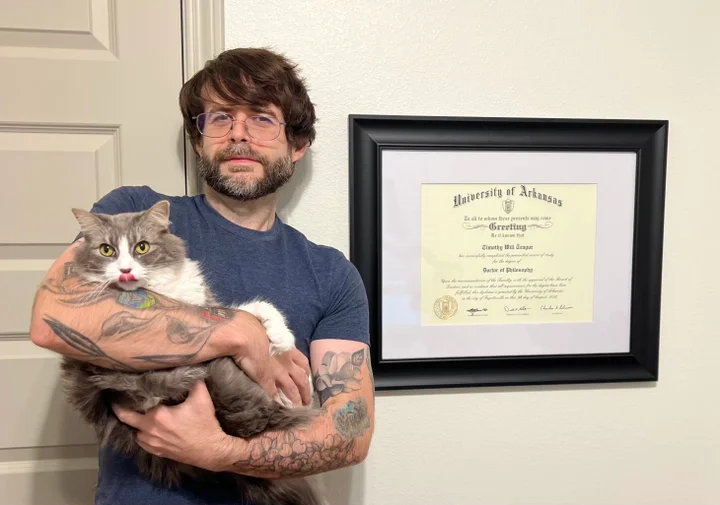
I’m just wondering who and how to contact the dilf in the photo
I’m surprised the college is allowing him to fail them
Except he isn’t. He decided not to punish them.
We fail students, especially en masse for cheating, all the time; this idea that we dont is anti-intellectual BS conservatives have spread around to descredit university systems. “Everyone passes because the woke means nobody can be excluded and everyone gets their participation trophy” nonsense.
Woops you don’t realize I have worked in a couple colleges over the past 10 years, and also have friends who work in other colleges, and have seen how professors are pressured/forced to pass students who shouldn’t. But it’s not part of some “woke” shit, it’s because the college doesn’t want to lose a paying customer, and it also makes their numbers look better to recruit future students. I’m surprised, but happy, to see not all colleges are going this path because it really is some slimy shit.
What did you do at those universities (and were they notably accredited)? There’s a world of options here, and the difference in areas of budgetary interest between being something like a provost vs. a lab manager is vast. Both deal with budgets, but the familiarity with the broad scope of the uni’s budgetary policy vs. the realities of budgetary specifics is very relevant to the impression you present here.
For example, a reputation for enforcing academic rigour greatly improves things like grant allocation, which cover far more of a university’s budget than a small percentage loss of tuition from academic dismissal of students does. That is not an aspect addressed directly below the level of deans (or program leads at larger unis, and PIs at research-heavy ones) but one that has a tremendous impact on the daily operation of the institution.
It’s just not an either/or issue here, and in general academic dismissal is a net zero for a university because of those huge areas of unstated complexity.
It’s plagiarism with extra steps.
Or
It’s plagiarism all the way down.
It’s just plain ol’ plagiarism, AI isn’t doing anything new except lower the barrier to entry.
Plagiarism with extra layers may be more accurate. Before they would just copy a few sources or just wikipedia like the author says. Now they’re using the plagiarism engine. It’s built upon plagiarism, it is its lifeblood.
The most common form of plagiarism in highschool might have been just copying wikipedia, but certainly in college the most common version (prior to gpt) was copying the structure and form of the arguments but reworking the details and language used - which is what GPT does.
before that, was various sites have essays written, or had a preview of the essay subject you are about to write. so people copies it or just modify it slightly. like essay of a non-fiction book you have to write, is readily online in various sites prior to AI, either as a introduction paragraph or with the thesis, people just lift it off there.
i think that has a less effect on college, COnservatives dont go to college so that wouldnt count. plus participation grades have been around for decades, ever since early 2000s and its mostly for BUDGEt reasons for the school, they dont care if the person fails or not in the future, and they did the disservice by passing them in HS when they should be repeating it.
The idea that conservatives don’t go to college is silly. They go to college, and while having a college education does have an impact on a person’s political leanings, it’s not the outsized one that gets played up in the culture war.
Data from the US:

Participation grades exist, I’ve taught classes that have them - but they seldom give credits towards degrees, and they aren’t a thing in accredited programs (in fact the opposite is usually the case, competitive programs generally have massive classes where you’re required to fail hundreds and hundreds of students at a time. The most soul-sucking experiences I have ever had while teaching have been running 600-1200 person weed out classes).
The funding process of a university is not straightforward - but no, the loss of a set of students, especially for cheating, is not a budgetary concern at an accredited institution. Academic standards enforcement is a condition for accreditation, even.
Are you a college professor in the US? I’ve been considering attempting to go that route, but I don’t know if it’s actually worth it, considering how few and far between the positions are, and that most universities seem to employ mostly adjunct professors at seemingly slave wages. Am I just being pessimistic, or is it as bad as it seems? I want to teach creative writing. I plan on teaching English as a second language when I finish out my bachelor’s.
You’re right about the adjunct professor situation, it’s really BS and should be illegal. They will get away with doing it as much as possible. I think a lot of professors have to start that way until an opening comes along
[not the person you asked]Colleges are having a rough time of it in today’s political environment, so keep an eye on that, too.
Does you college library subscribe to the Chronicle of Higher Ed? I find it neat to read the headlines, see what other people are thinking on.
which subject? faculty positions are very competitive to be honest, especially in stem, and if your doing research , you should have written science papers, or been published quite a few times. since its teaching english.essay writing, some colleges might be desperate enough for english teachers, faculty positions seems hard to get , because there are tenure, and you might be a temporary hire/adjunt. i just know stem/bio department is super competitive asf.
Great article.
How do we teach that when a student doesn’t want to learn?
Good question. But maybe we’ve gone overboard with the density of information and we just need to relax a little and give the kids their childhood back.
So I’m a flight instructor. I–unlike a shocking number of college professors–was taught how to teach.
Today’s subject: Thorndike’s principle of readiness. Students learn best when they’re ready to learn. What does it mean to be ready to learn? Well, we turn to Maslowe and his hierarchy of needs.
If you took a Psych 150 class, you probably studied Maslowe’s hierarchy of needs as a pyramid, with the wide base layer being the physical needs like food, water, moderate temperatures, sleep etc. then the safety and security layer, then the social layer, on up to the “self actualization” layer at the peak which presumably means becoming a Star Trek TNG character. This model is a bit flawed because it prescribes one set of priorities for all people, at all times. But it’s useful I suppose as a model to start from, and it will do for us.
As a teacher, you have to ask yourself: What need on my students’ pyramid is my lesson going to serve? If you’re a Russian literature teacher or something, that “need” is probably pretty high up the pyramid, right? You’ve got to have a lot of the rest of your life pretty thoroughly solved before you go “I’m sick of novels written in the Latin alphabet, let’s give one of the ones in Cyrillic a try.”
Is that where most undergraduates are in their lives?
No; the majority of them have just had their social lives upended by graduating from high school, having most of their childhood friends and acquaintances move away and now having to make new friends, quite often having physically moved themselves to a new town away from their parents and support networks. Many of them are falling chin first into doing domestic chores for themselves, learning how to feed themselves, wash their clothes etc. A number of them have dependents already and have to work to support them, others simply have to work to feed themselves.
Why are they even here? Well, they’ve been told–lied to, really–that sitting through four years of your shit will somehow cause employers to pay them more. A woman in a UNC lanyard walked into a high school class I was taking to assert exactly that complete with a Powerpoint presentation full of charts.
Your gaggle of undergraduates is also likely in significant debt. They might have walked into that career center that their campus tour guide made such a big deal about maybe trying to arrange an internship or something only to be handed the classifieds page out of the local paper, or gone to one of those pointless career fairs at which no one ever seems to get hired.
And in amongst all that, there stands the humanities professor, more self-important than the Baptist god, bitching about students using ChatGPT to write their essays.
I didn’t really have much of a problem with that teaching flight school. First of all, all of my students wanted to be there. Nobody goes to flight school for resume candy, they do it because they want to fly a plane. Genuine curiosity in the subject will put students most of the way through the textbook themselves, when I was a flight student I’d ignore high school or college textbooks to read my flight school books. But then you’ve got things like the weather. Meteorology is boring and dense, especially given all the abbreviations they cram into it. It is the teacher’s job to demonstrate why this is important to the student. “So you don’t crash and die” often does the job.
It’s not the density of information. It’s the end goal of the process. Students are only given motivation to learn for a career and people have figured out that most jobs are bullshit. If they can bullshit their way though college, they can bullshit their into a career. When layoffs are done by lottery, it’s not even like the sincere students can be safe. It’s bullshit stacked on top of other bullshit.
I was thinking of primary school. I’d say back then learning is more intrinsically motivated if not overdone.
So am I. From the very beginning, kids are constantly asked what they want to do when they grow up, which should be fine, but the adult asking that will always follow up with a suggestion.
You’re right, if there’s anything wrong with education in the US, it’s that we do too much of it 🙄
I think a fair argument could be that we have the wrong mix, the wrong emphasis.
For example, my kids history class focusing more about memorizing dates and names rather than the broader picture. We need history, but rote memorization of the trivia isn’t that helpful. More analytical perspective about connecting events to outcomes and comparing the scenarios to one another, but I suppose that’s too hard to fairly grade and so we don’t like it…
Rote memorization is the lowest of four levels of learning. It’s the easiest to achieve, the easiest to test, and the least useful. Guess what our entire goddamn education system has designed itself around?
This was goodly written;
How do we expect students to want to learn when the point of school is to get a piece of paper that says you get paid more?
People care about their careers, because that’s what’s going to let them survive, they don’t care about the journey to getting to the point of stable survival.
If school wasn’t about getting done as fast as possible so you can go make money, if people didn’t have to constantly minmax their time and money, then people would actually want to learn and go to school.
I’m all for letting children be children, but this article is about college students who are, generally speaking, supposed to be adults.
Fair.

You would not believe how many seniors use this ploy.
Interesting post, would be good to support the author/publisher with a source link. Especially since it isn’t pay walled.
Had trouble with this myself teaching. Students this semester have been good about it (probably because I’ve been very explicit in my contempt and also it kept blundering) but last semester was tricky.
One thing I learned was I need to also insist no Grammarly. That used to be allowed but it makes original writing sound very AI. I also riddled my assignments with short oral segments and personal stories.
It cuts into class time but I’ve managed to make those sessions educational since my “presentations” are always conversations w/ students. No ppts. Actually kinda fun and very much weeds out cheaters lol
deleted by creator
Students would want to learn instead of doing less work if there were incentives to learn instead of just get out with a degree.
There are incentives to learn. The smartest kids do far better than the average kid.
Maybe in school
In the real world, the luckiest people do the best.
no way, all studies show students who do well academically out preform their peers post education.
Did it mention and account for the economic class of the students?
yes of course
Sweet
Then it would account for how the students who are luckiest have more successful lives.
yes but thats besides the point. The point is that people do better in life if they do well in school. Pointing to a tiny subset of people and saying “but these people also do well” doesnt change anything and I genuinely think you’re intentionally trolling.
Sadly, lockdown era students all got their WFH piece of paper they can safely wipe their asses with. We have never had so many grad students fail out as this cohort. They literally got degrees with no practical knowledge, tehn thought tehy could cost to a career with the same work ethic.
Well they’re still getting jobs and are instead just learning on the iob
They just need to learn to make AI do it. Then they can do more than most.
It seems AI is putting more light on this problem of the academic system not really being learning oriented.
Not that it matters. There was already enough light on it and now it’s just blinding.
Here’s the link to the actual article. I get that you’re trying to do users a favour to bypass tracking at the original URL, but the Internet Archive is a Free service that shouldn’t be abused for link cleaning as it costs a lot of money to store and serve all this stuff and it’s meant as an “archive”, not an ad-blocking proxy.
I’m posting this in part because currently clicking that link errors it with a “too many requests” error. Let’s try to be a little kinder to the good guys, shall we?
If users wasnt a cleaner/safer/faster browsing experience, I recommend ditching Chrome for Firefox and getting the standard set of extensions: uBlock Origin, Privacy Badger, etc.
Fuck it. Let’s make the Internet Archive only accessible from public libraries. And you will have to physically go to a library to access it. No accessing the archive through your library’s website.
I could also be convinced to make the Internet Archive only accessible from a series of elaborate temples we build just for this purpose.
Regardless of the method, the point is that the Internet Archive still exists and serves its core purpose. It loses some convenience of scholarly access, but in turn it now becomes useless as a paywall bypass mechanism.
Yeah, especially if it’s not paywalled.
It deprives the original source of traffic too, even if it’s Adblock traffic.
Any free service is bound to be exploited to the fullest possible extent. It’s the depressing fate of so many internet projects.
I can’t be bothered to pay attention to anything UK related. Its like Greenland and Antarctica to me.
Ok? That’s a weird thing to say…
This just in, today’s soup is really hot and really wet.
Back in 2001 when I went to college they gave us a warning not to plagiarize reports and assignments. Saying they had sophisticated tools at their disposal and sites like cheat.com
Fun fact: at that time (and maybe still now since I checked a while ago) cheat.com was a porn site. So they were full of shit.
But AI detection is being really, really scary since the amount of false positives are staggering.
Solution, begin requiring students to work inside a monitored room where they have to log in to access and have to write down everything by hand on paper that remains in the room. No electronics allowed inside, only notes regarding the research they may have done are allowed. These notes would have a similar process to be gathered, you’d have to register your access to the reference you are going to be sourcing, likely limited to those printed in the library, and save them there to be used when writing the report. Make them go through metal detectors on the way and get rid of any piece of electronics they could cheat off of.
Who am I kidding, Idiocracy seems to have been spot on.
I am currently at a university. Everything that is written is normally turned in through ‘turn-it-in’ that does all the checking. I get a percentage of quotes, plagiarism, and it scans references. They have also added in a preliminary AI scanner that tells 'possibility ’ of ai writing.
One time i plagerized my name and page numbers according to turnitin
Lol. Sounds right. We see it as a percentage and it highlight what was plagiarized and the sources it is pulling it from, to include past university assignments. So yes, you can be hit for that - but then the human grader would see it as a false positive.
I am glad I graduated a long ass time ago. The last time I took any major education was a coding bootcamp and it was just on rhe cusp of the first iterations of chatgpt and other such shit.
I never plagiarized, and i was never accused of plagiarism. I am glad that i did this before any of this AI nonsense.
Idiocracy made one critical mistake… the biggest idiots are the ones in charge. In idiocracy the president and his staff were actually far smarter and more dedicated to doing a good job than the fuckers currently in charge.
Were they, or were they simply more desperate because after centuries of mismanagement they no longer had the luxury of the inherited power, wealth, and resources they had relied on, being left with only the ineffectual slogans they had been brainwashed with instead?
I mean, there are a lot of places that are way too happy about monitoring everything you do on a computer or phone, I doubt they’d want to part you from your digital shackles - they’ll instead force you to use shitty monitoring apps to “ensure you don’t cheat”
Yeah, cheat.com forwards you to phonesex.com that has the number 1-800-PHONE-SEX you can call to get help fucking yourself.
It should be treated the same as if another student wrote the paper. If it was used as a research tool where you didn’t repeat it word for word then it’s cool, it can be treated like a peer that helped you research. But using it to fully write then it’s an instant fail because you didn’t do anything.
Okay, sure. But how can you identify its use? You’d better be absolutely confident or there are likely to be professional consequences.
Not to mention completely destroy your relationship with the student (maybe not so relevant to professors, but relationship building is the main job of effective primary and secondary educators.)
Have the student submit drafts with the first rough draft written in class and submitted at the end. Then weekly or daily improved drafts. If the finished paper is totally and material different then it’s a red flag. If the student wants to drastically change the paper then the teacher must approve.
“Chat GPT, this is my rough draft. I want you to polish it a little and add some, but not a lot. This is meant to be a second pass, not the final draft. Make a couple mistakes on the grammar.”
Can easily be faked with AI. You can just prompt AI to make outlines, drafts, mistakes, fix the mistakes, etc.
I’ve presented on this at teacher conferences, for what it’s worth. There’s no effective way to detect AI usage accurately when the text-writing process isn’t supervised. The solutions need to accept that reality.
Then papers will all have to be written in person on an internet free machine or hand written.
Or we could focus on the core of teaching, which is building relationships with students. Then, with that rapport, students will trust their teachers when they explain why getting AI to do the work for them is hurting their own education. We can also change our assessment practices, so that students don’t feel the pressure to write a “perfect” essay.
And, yes; occasionally require students to do a bit of writing with invigilation.
that is an unrealistic solution
True, it has never been tried before.
Well said! It’s like plagiarizing from another student. Using AI as a tool is one thing, but completely relying on it to write the paper is cheating in my book.
Don’t really know how to feel about this because 15 years ago, all I did was reword Wikipedia pages to make a good paper. I went to college because I was led to believe it was a requirement to do well in life. I still learned a lot, but that was mostly through the social interaction of coursework. And honestly, I don’t use anything from college in my current engineering job, it was all on-the-job panic learning. If I were to go back to college today, it would be such an enlightening experience of learning, but when you’re a kid getting out of high school, you’re just trying to get by with some gameplan that you’ve only been told about. Idk. I don’t blame them for using a tool that’s so easily accessible because college is about fun too. I guess I wouldn’t do it different at that age .
I think that rewording wikipedia is slightly better though. It still requires you to digest some of the information. Kind of like when your teacher let you create notes on a note card for the test. You have to actually read and write the information. You get tricked into learning information.
Ai, just does it for you. There’s no need to do much else, and it’s reliability is significantly worse that random wiki editors could ever be. I see little real learning with ai.
With AI you cane solve an assignment without:
- reading the assignment
- reading the source of information
- reading the answer that “you” “wrote”
With the rewording Wikipedia approach you had to do all of those three things
Another thing is, you often gain interest on the topic, and Wikipedia indeed has the neat little thing of articles being related to each other, so it’s very plausible to start on Chandler Bing and end on the Atlantic slave trade, for instance. With LLMs, this is much, MUCH rarer, considering whatever you find interesting must be researched manually, since LLMs are more or less useless.
Apparently you learned to learn, which I suppose is one major goal of college.
I’m in the same boat, and for me personally no, in uni I learnt to do as minimal of a job as possible to “pass” the arbitrary goals set by uncaring world. I had to unlearn all of that very quickly when I got my first real job that I actually like. My uni broke me, for sure, and I’m lucky I fixed a little bit of that decades later.
I’m sorry to hear that.
Would you say that your experience was typical or was it especially bad for you (as in not designed for your needs) while other people were better off?Not the best university at the time, in not the best country, so I’m not unique in that. Teaching practices were literally the opposite of what scientifically recommended. But on top of that, neuro diversity wasn’t as normal back then, so not only I wasn’t diagnosed, but I had to mask as hard as possible, which didn’t help at all.
Only very specific type of people thrived in that environment, everyone else coped, some more successfully that others.
That’s a nice ideal but the reality is that this world is cruel and we’re burdening future generations with debt for their degrees and the job market sucks. If reality was different, then maybe kids could enjoy learning in college. But it’s not, so they need to make sure they are capable of being good little sheep that can do what the C suite wants otherwise they’re going to be in poverty and debt for the rest of their lives with very little safety net.
US here, in case it wasn’t obvious.
You hit the nail on the head.
The problem is the cost of education in the US.But not all of the world is such a capitalist hellscape as the US is, where people were embezzled of affordable living, healthcare and education.
That doesn’t make the concept of education a bad one. The framework in which it’s implemented is to blame and the people who created said framework.
This refrain I keep hearing of “I don’t use anything I learned in college” is an INSANE take. Unless you went to some fly-by-night for-profit scam college, you learned way more than you think, even if it didn’t include some specific engineering technique. You mentioned social interaction, but critical thinking is the big one. We need to stop devaluing education-it’s critical for our future. We can’t dismiss it just because capitalist vultures are ruining it. We need to fight to make it what it should be.
You pay to go to college. Then essentially do the equivalent of lighting that money on fire by not engaging with the product/services you just purchased.
In America you go to college at 18. It’s hard to have perspective. I’m almost 40 and reflecting on how powerful my degree was, because of how it taught me to think.
Even when I had teachers tell me this to my face at 18 I didn’t understand it.
Well yeah, I was the same because at 18 I didn’t understand how to think yet. Also because I hadn’t experienced those who never learned. At 31 I cherish the education I tried to avoid in my teens.
I went to college at 18. I wasn’t ready for it. I floundered for a few years, gaining no valueble life skills nor experiences, then dropped out and moved across the state and starting working and being an adult. Through that process I got to where I could appreciate college, understand what these amounts of money that are being talked about, that I’m spending in my daily life actually are worth so when I went back to college a few years later I could truly appreciate both the opportunities it presented to me, and how my life was being impacted. I’ve literally trippled my income from just a $20k (before financial aid) two year degree just a few years after graduation.
When your high school is just a conveyer belt into college, you don’t appreciate college, it’s just another school, and you just have to work through the classes finding the paths of least resistance between where you are now and the final goal of graduation. You don’t get to understand what college is about, you don’t get to understand how incredibly unique the time you spend in college is compared to the rest of your life, how this is the only time in your life when your focus is studying, learning and to gain as many skills and experiences and friends and contacts as you can.
I kinda forgot where I was going with this but it adds to the discussion to I’m going with it
Yes and no. You pay for a college to recognize your competency and say it to the world. That’s why so many students use AI
That’s akin to getting a driver’s license to prove you can drive - but not sitting behind the wheel a single time, and paying someone else to do your test.
No skills learned, nothing gained beyond a piece of paper.
Students might think they’re being slick by pushing all the work to AI during their degree, but their new boss in the real world will quickly recognize that they do not have the skills they should have according to their certification and say bye-bye during their probation period.
driver license actually has a use, its a requirement to drive. its more akin to have certification for different professions, rather than the degree.
There’s no competency to recognize if you’re using AI instead of processing the material yourself. Only a scam that swings both ways.
You pay a bad college to recognize your competency.
A good college teaches you how to reach beyond what they teach you.
This. While I do agree that college is largely you proving to others you can learn a lot of something(s) and commit to something(s) in the long run, college can just be a purchased vessel to some.
How many pay for college because they want to learn vs because it’s a requirement?
I also skip through bullshit i dont care about but am required to do.
I went to college because I wanted to learn new things. And I did.
Happy for you 🥹